Digital sovereignty is built on an open standard that enables federation
Across Europe, sovereign communications systems are already being deployed, and crucially, they don’t have to exist in isolation. An overlooked part of achieving genuine digital sovereignty is ensuring that an organisation has the ability to switch easily between vendors to guard against vendor lock-in.
It’s a sentiment that was perhaps best expressed by Karsten Wildberger, Germany’s Federal Minister for Digital, at the Summit on European Digital Sovereignty in November 2025: “Digital sovereignty means having choices, so no single technology and provider becomes a dependency that can be used against our interests. It is always good to have choices in order to avoid dependencies.”
Without the ability to easily switch between vendors, an end-user organisation remains beholden to a specific vendor. It gives a vendor too much power over the end user organisation. For example, it’s preferable to swallow a doubling in price than to ‘rip and replace’ an incumbent solution.
At the more alarming end of the spectrum, it creates major vulnerabilities. A recent example is Ukraine suffering the loss of satellite imagery supplied by Maxar Technologies, as the US vendor implemented a decision made by the US government. In a similar incident, email services to Karim Khan, chief prosecutor at International Criminal Court (ICC), were suspended as a result of a US government sanction. The ICC has since gone through the rip and replace pain of moving from Microsoft Office to openDesk, a sovereign alternative.
Interoperability delivers digital sovereignty
Governments’ adoption of digitally sovereign solutions, to avoid a dependency on a single vendor, is the right strategy to take in an increasingly sharp geopolitical climate. Even a vendor that is currently trusted cannot be trusted into an unseeable future. A vendor can be acquired, possibly by a company that’s headquartered in a non-trusted country. A vendor could be completely compromised as a result of a cyber attack, or nation-state sponsored malicious insider. A vendor could grow into a monopolistic position - especially if a government standardises on that vendor - and then abuse its dominant market position.
While a solution could be from a European vendor, enable self-hosting, and might even be open source, it’s still not offering sovereignty if it’s proprietary style ‘vendor-locked’ software. This is especially true for chat-based solutions.
Chat should never be a proprietary-style vendor-locked solution
Chat apps have developed during a quite centralised era of computing. That those using WhatsApp can only communicate with others using WhatsApp has, somehow, never been seriously questioned. Likewise, it’s only Signal to Signal, Slack to Slack, Teams to Teams, Threema to Threema, WebEx to WebEx, Wire to Wire, Zoom to Zoom. They are all walled gardens - siloed systems - that don’t interoperate.
Chat has never suited a proprietary model, because it often involves people who use different technology. The original open internet is a huge success because it enables communication through common standards. People can upload information stored and managed on their own system, and make it available to others via the Web.
Email is similar; it doesn’t matter what email system you use, you can send an email to anyone because it’s based on a standard on which all vendors operate. No one ever asks if you use Microsoft Outlook, Gmail or Apple Mail as - thanks to interoperability - it doesn't matter.
As a result (despite email being arcane and insecure) there’s still a healthy competitive ecosystem of email providers and switching between them isn’t a massive headache. Decades of emails can be seamlessly managed during an email migration, unlike years of chat history moving from Slack or Teams to some other proprietary system. As for WhatsApp or Signal, well, as consumer messaging apps they shouldn’t even be used within the workplace.
The role of Matrix for sovereign communications
Matrix is an open standard for decentralised communications. The protocol enables self-hosting, resilient communications, interoperability and end-to-end encryption.
There’s well in excess of 200M people already using Matrix, and more than 150K Matrix deployments. More than 25 governments around the world have already deployed Matrix-based systems. There are more than 40 software vendors in the Matrix ecosystem, and at least 30 major primes, systems integrators, services firms and hosters offering Matrix-based solutions.
The German healthcare system has developed its own standard, TI-Messenger, built on top of Matrix, that’s already implemented by public healthcare insurers. It’s currently being rolled out to local healthcare providers and will eventually support the vast majority of Germany’s 83M citizens.
The Matrix ecosystem provides the ‘digital commons’ that ensures genuine digital sovereignty. Governments and public sector organisations have complete ownership and control of their communications solutions, with the ability to easily choose and switch between vendors, and federate with each other through their own sovereign systems.
Sovereignty without isolation - Matrix-based federation
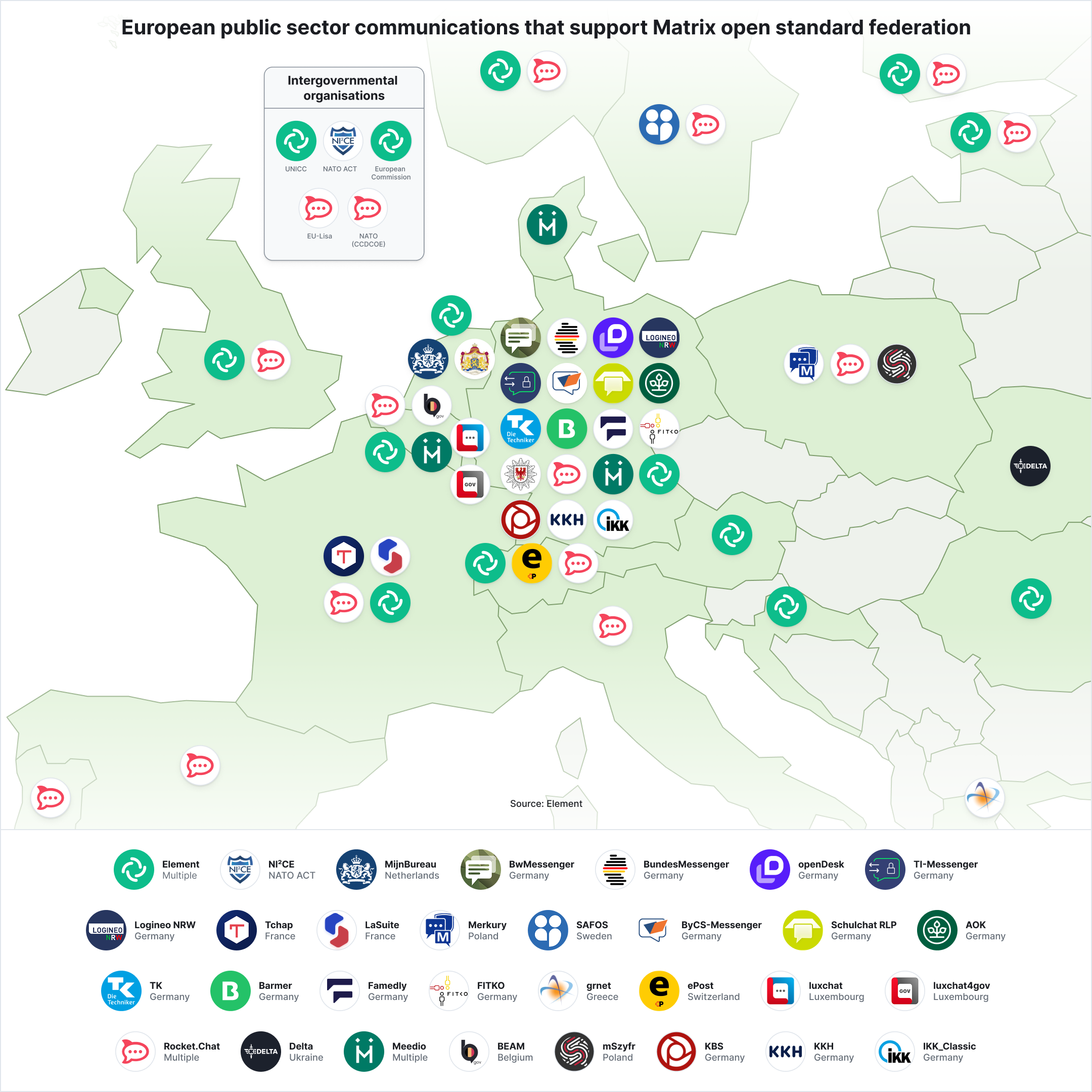
Choosing a communications solution based on an open standard to ensure digital sovereignty brings another significant benefit. The Matrix open standard not only ensures a competitive ecosystem - it enables each independent Matrix stack to connect with any other (assuming both parties want to connect, of course).
It’s the very opposite of a standard proprietary-approach, where all parties have to use the same vendor. The Matrix open standard enables solutions from different vendors, and those developed in-house, to federate. This means sovereignty does not come at the cost of interoperability, which is a balance that ‘walled garden’ proprietary systems cannot deliver.
In other words, all 27 EU members, and the EU itself, could all have their own sovereign Matrix-based solution for communications. And they could all remain in their specific solution (which is perhaps tailored to meet their own country-level requirements), while all being able to federate with each other.
We’re already seeing this play out. Germany’s public sector has multiple Matrix-based systems including the openDesk office suite, BundesMessenger and BwMessenger. Meanwhile, The City of Cologne runs Rocket.Chat enabling it to benefit from Matrix-based federation if it wishes. The French government is standardised on Tchap, which also sits within LaSuite; France’s sovereign office suite.
Sweden has SAFOS Chatt, its own Matrix-based chat. Elsäkerhetsverke, the Swedish Electrical Safety Authority, uses Rocket.Chat and could therefore use Matrix-based federation to connect with other organisations. The European Commission and the UNICC use Element, NATO ACT uses its Matrix-based NI2CE Messenger. EU-Lisa and NATO Cooperative Cyber Defence Centre of Excellence (CCDCOE) both operate on Rocket.Chat so, again, can also federate using the Matrix open standard.
If they so desire, all of these country-specific communications platforms can federate - ensuring digital sovereignty and enabling cross-border federation. All without a dominant vendor, and all completely without any level of vendor lock-in.
Taken together, these deployments form a growing, federated network of sovereign communications across Europe - not a patchwork of silos, but an interconnected ‘network of networks’ ecosystem. Digital sovereignty, when built on open standards, enables communications without vendor dependency.